Showing posts with label exercise. Show all posts
Tuesday, June 3, 2025
VIDEO: D-Bell Chest Press
Sunday, November 14, 2021
VIDEO: Blast your Pec's w/ new soreness by doing this 1 simple trick to your Chest Press workout
The pectoralis major attaches to the upper bone of the arm, called the humerus, and is divided into two parts. The clavicular head makes up the upper part, and the sternal head makes up the lower part.
The muscle fibers of the pectoralis end in a flat tendon, which is inserted into a groove called the intertubercular sulcus, in the upper humerus located in the upper arm.
The pectoralis major controls various actions in order to move the shoulder joint:
- Clavicular head flexes the humerus, as in throwing an underhand ball
- Sternocostal head adducts the humerus, as when flapping the arms
- Pectoralis major medially rotates the humerus, as when arm wrestling
- Pectoralis major keeps the arm attached to the trunk
Monday, July 22, 2019
3 Exercises to Help you Develop a Better Butt..
There’s no denying it but "the butt" is having one of its moments. Look on any fitness page and you’ll find a myriad of articles on how to get a toned, firmer and bigger butt. Whatever your booty goals are you’re probably tired of hearing of squats! Despite the many exercises available to work your glutes, squats seems to crop up time and time again as the ultimate glute exercise despite the fact they work your legs equally and even predominantly unless you have your form down! So below we’ve listed three killer exercises to target your glutes specifically.
SINGLE LEG GLUTE BRIDGE ext.
This is an amazing move for working your glutes as well as your hamstrings; with no equipment required, there’s no reason this shouldn’t be in everyone’s workout arsenal! All you need is a flat surface… simply lie on your back with your feet flat and knee bent, arms resting at your side with palms down to give you stability, then extend one leg at a time and lift up into a glute bridge. Make sure to squeeze your glutes as you’re lifting up and hold for a few seconds at the top of the bridge before lowering.
DONKEY KICKS
Another killer glute move with no equipment required! Donkey Kicks work all three of the major groups, Gluteus Maximus, Gluteus Medius and Gluteus Minimus so they are the ultimate move to lift and sculpt your butt! Your starting position should be a tabletop position with your hands placed below your shoulders and your core engaged. Then using alternate legs squeeze your glutes and kick your leg up behind you in the air keeping your legs bent at a 90-degree angle the whole time. To make it more challenging you can add ankle weights!
BARBELL HIP THRUSTS
Barbell Hip Thrusts are the best for building size and strength because of the full hip extension motion which most glute exercises don’t use! This is the primary function of the Gluteus Maximus, so when an exercise uses this movement this allows you to fully engage your glutes.
Location:
Mission Hills, San Diego, CA, USA
Thursday, March 28, 2019
Friday, June 1, 2018
PROOF NOW EXISTS THAT EXERCISE DOES INDEED SLOW THE AGING PROCESS

Researchers have recently shed light on how exercise benefits the body on a cellular level. What’s more, they’ve determined a type of exercise that’s best for boosting cell health.
Published in Cell Metabolism (2017; 25 [3], 581–92), the study included 36 men and 36 women categorized as:
Each participant was assigned to one of three training programs for 12 weeks:
- “young” (aged 18–30) or
- “older” (aged 65–80).
- high-intensity interval training (HIIT) on an indoor bike;
- strength training with weights;
- or a combination of the two.
Study leaders took muscle biopsies from the volunteers—who also underwent lean-mass and insulin-sensitivity tests—and then compared the results with those from a sedentary control group.
Data showed that the exercise groups experienced improvements in cellular function and in the ability of mitochondria to generate energy; this adds further evidence that exercise does in fact slow the aging process at a cellular level. Muscle mass and insulin sensitivity improved with all three training protocols. However, outcomes did vary.
“HIIT revealed a more robust increase in gene transcripts than other exercise modalities, particularly in older adults,” the authors explained. Specifically, HIIT increased mitochondrial capacity by 49% in the “young” group and 69% in the “older” group.

For best benefit, according to the study, a combination of strength training and HIIT is recommended. While HIIT proved best at improving cellular health, it was less effective at increasing strength and muscle mass than the strength training protocol.
“We encourage everyone to exercise regularly, but the take-home message for aging adults is that supervised high-intensity training is probably best, because, both metabolically and at the molecular level, it confers the most benefits,” concluded K. Sreekumaran Nair, MD, PhD, a Mayo Clinic endocrinologist and senior researcher on the study.
Location:
Mission Hills, San Diego, CA, USA
Tuesday, January 23, 2018
Friday, May 10, 2013
CASE STUDY: Not only does Weight Resistance Training Benefit the Body but the Mind as Well
You probably know that strength training has many physical health–related benefits, including:
- a lower risk of all causes of death
- fewer heart attacks and strokes
- improved body composition (Garber et al. 2011)
However, did you know that it can also help with your mental health? O’Connor, Herring and Caravalho (2010) completed an extensive review of the research on this topic, admitting only studies that met certain criteria for quality research.
So what does the research show? Amenda Ramirez, who has a degree in exercise science from the University of New Mexico, Albuquerque (UNM), and Len Kravitz, PhD, the program coordinator of exercise science and a researcher at UNM, summarize highlights of the findings below.
Resistance Training and Anxiety
While it is normal to experience anxiety in relation to interviews, tests, new challenges or performances, prolonged anxiety is associated with sleep disruptions, mental distress, bodily pain, poor health and limitations to physical activity.
From the seven resistance training studies on this topic that met the criteria for inclusion in the review, the researchers conclude that resistance training is a meaningful intervention for people suffering from anxiety. Interestingly, two of the seven studies compared the effects of high-intensity resistance training (exercises performed at 80% of 1-repetition maximum [1-RM]) with the effects of moderate-intensity training (50%–60% of 1-RM) and found that the lower intensity was more effective in reducing anxiety.
Resistance Training and Improved Brain Cognition
Cognition refers to your brain’s processing ability to obtain knowledge through thought, experience and the senses. Cognition research attempts to determine how we transform events and experiences into stored memory, which can be recovered and used to complete mental and physical tasks. Highly associated with cognition is executive function, the “command and control” conductor of cognitive skills. This brain control center manages all of the tasks in your life, such as writing an article, doing a research project, preparing for a class and organizing a trip.
A great amount of research on exercise and cognitive function has been completed with older adults as subjects, as it’s been felt that exercise might offer this population consequential benefits in this area (Colcombe & Framer 2003). O’Connor, Herring and Caravalho note that seven randomized controlled studies show that resistance training improves several aspects of cognition in healthy older adults. Uniquely, one of the most profound effects is a marked improvement in memory and memory-related tasks. Additionally, it appears that improved executive function is a major benefit, both of resistance training (Anderson-Hanley, Nimon & Westen 2010) and of cardiovascular exercise (Colcombe & Framer 2003).
Resistance Training and Self-Esteem
Self-esteem is a person’s self-opinion. High self-esteem is strongly associated with positive physical and mental well-being. Resistance training has been shown to improve self-esteem in healthy adults (both younger and older), in populations with cancer or depression and in people undergoing cardiac rehabilitation.
Resistance Training And Sleep
As you have probably already experienced, insufficient sleep is a problem for your physical and mental health! Consistent sleep deprivation (less than 6 hours a night) is associated with:
- cognitive impairment
- mental illness
- hypertension
- obesity
- cardiovascular disease
- stroke
- daytime sleepiness
- motor vehicle accidents
- an overall diminished quality of life
Anderson-Hanley, C., Nimon, J.P., & Westen, S.C. 2010. Cognitive health benefits of strengthening exercise for community-dwelling older adults. Journal of Clinical and Experimental Neuropsychology, 32 (9), 996–1001.
Colcombe, S., & Framer, A.F. 2003. Fitness effects on the cognitive function of older adults: A meta-analytic study. Psychological Science, 14 (2), 125–30.
Garber, C.E., et al. 2011. Quantity and quality of exercise for developing and maintaining cardiorespiratory, musculoskeletal, and neuromotor fitness in apparently healthy adults: Guidance for prescribing exercise. Medicine & Science in Sports & Exercise, 43 (7), 1334–49.
O’Connor, P.J., Herring, M.P., & Caravalho, A. 2010. Mental health benefits of strength training in adults. American Journal of Lifestyle Medicine, 4 (5), 377–96.
Monday, December 31, 2012
Thursday, October 11, 2012
PINK EVERLAST FITNESS BALL WITH WORKOUT POSTER TO PROMOTE NATIONAL BREAST CANCER AWARENESS MONTH
PINK EVERLAST FITNESS BALL WITH WORKOUT POSTER
BIG 5 SPORTING GOODS COUPON
Great for Crunches & Other Core Strength Exercises!
• PUMP INCLUDED
• PUMP INCLUDED
Sunday, March 18, 2012
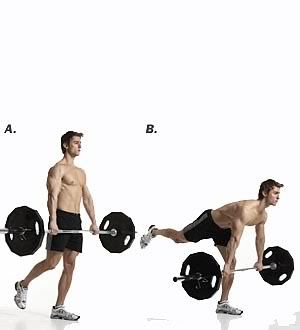
Hamstrings: Single-Leg Barbell Straight-Leg Deadlift
Hamstrings: Single-Leg Barbell
Straight-Leg Deadlift
The benefit: Besides targeting your hamstrings, this
exercise works your glutes and core. It also helps eliminate muscle imbalances
between your legs, reducing your risk of injury.
How to do it: Grab a barbell with an overhand grip
that’s just beyond shoulder width, and hold it at arm’s length in front of your
hips. Stand with your feet shoulder-width apart and knees slightly bent. Now
raise one leg off the floor.
A. Without changing the bend in your knee, bend at
your hips (don’t round your lower back), and lower your torso until it’s almost
parallel to the floor
B. Pause, then squeeze your glutes, thrust your hips
forward, and raise your torso back to the start.
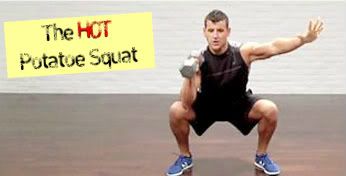
VIDEO REPORT: The HOT Potatoe Squat
| Do as many reps as you can in 50 seconds. Then rest for 50 seconds and repeat two more times. |
The hot potato squat may sound like a kid's recess activity, but don't be fooled -- it’s also a cutting-edge fat-loss exercise that will get your heart pumping and your muscles burning in almost no time, says Gaddour. It starts with one of the most effective exercises invented: The squat. When done correctly, a squat trains a lot of muscles, particularly big ones like your quadriceps, hamstrings and glutes. In fact, it burns more calories per rep than almost any other exercise.
But why stop there? Throw an airborne dumbbell into the mix to make this classic move even MORE challenging and beneficial. Holding the weight on just one side of your body increases the demand placed on your core to keep your body stable; as the weight changes from side to side, your core muscles are worked from every angle.
Sunday, December 4, 2011
Wednesday, October 5, 2011
Subscribe to:
Posts (Atom)